The Brain You Never See: AI Inside Telecom Operations

Trusted by:
























Telecom networks have become too complex for humans to manage alone. Every fiber rollout, every 5G slice, every virtualized service adds more moving parts. OSS and BSS systems were supposed to tame this chaos, but for many engineers, they’ve become bloated data warehouses that are slow to adapt and perpetually out of sync with reality.
The real problem isn’t the volume of data. It’s that traditional OSS and BSS can’t reason. They automate tasks and raise alarms, but they can’t adapt when conditions shift. A fiber cut, a traffic surge, or a misconfigured virtual service sends cascades of false alarms or leaves critical issues buried in logs.
What telecom needs isn’t another dashboard. It needs intelligence that thinks. And thinks correctly.
That’s where AI in OSS/BSS enters, not as a visible tool engineers interact with, but as an embedded layer working quietly doing it’s thing behind the scenes. It interprets signals, corrects records, predicts problems, and protects revenue before anyone notices something’s wrong. Engineers might not see it directly, but they notice the results: cleaner inventories, fewer outages, reconciliations that finish in days instead of months, and financial numbers that finally match network reality. What a relief…
You want this kind of intelligence to almost operate invisibly, making thousands of micro-decisions every second and become an operational AI telecom brain.
Now that we’ve covered the basics, let’s look at why this type of intelligence has become essential rather than optional.
Why Networks Outgrew Human-Scale Management
Telecom networks crossed a threshold. The number of devices, endpoints, and services multiplied with 5G, IoT, and fiber expansion. No operations team, regardless of size, can track every adjustment in real time anymore. It’s nearly impossible.
OSS and BSS systems grew alongside this complexity, but instead of providing clarity, they created noise. Legacy platforms carry decades of accumulated data. Modern modules add layers from multiple vendors. The result? Conflicting records, duplicate entries, and alarms that fire without context.
Rule-based automation, once seen as the answer, has hit its limits. It handles repetitive tasks fine, but breaks down when networks behave unpredictably. Automation is rigid, built for yesterday’s conditions.
The Next Generation OSS and BSS Market is projected to reach USD 132.43 billion by 2030, driven largely by the need for AI-driven intelligence that can keep pace with modern network complexity.
The embedded AI layer is different. It lives inside OSS and BSS processes, making continuous micro-decisions and evolving its understanding as the network itself changes. Instead of overwhelming engineers with endless logs, it filters the data stream and identifies patterns that have real operational or financial significance.
Engineers may never see these adjustments directly, but they feel the impact. Alarms that once flooded dashboards get reduced to meaningful alerts. Reconciliations that used to drag on for quarters finish in days. Revenue reports align with the network instead of contradicting it. What used to require teams of people working overtime now happens automatically, quietly, in the background.
AI Has and Is Changing Operations and Revenue Protection
Traditional OSS has always been reactive. Something breaks, alarms fire, engineers respond. AI flips this dynamic by moving from detection to prediction.
In the grid below we explain the AI impact a bit further by listing some Use Cases. AI in OSS/BSS solves specific operational and financial challenges that traditional systems couldn’t address. Here’s how intelligence embedded in these systems delivers measurable impact across different use cases:
| Use Case | Traditional Approach | AI-Embedded Approach | Impact |
| Service Degradation | Wait for alarm thresholds to breach | Recognize patterns before failure | Prevent customer-facing outages |
| Inventory Accuracy | Quarterly reconciliation campaigns | Continuous auto-correction | Eliminate ghost services and wasted OPEX |
| Revenue Leakage | Discover losses after the fact | Detect billing anomalies in real-time | Protect margins before revenue escapes |
| Network Capacity | React to congestion | Predict saturation points | Proactive resource allocation |
| Compliance Reporting | Manual data collection | Continuous automated tracking | Turn regulatory burden into operational intelligence |
PRO TIP: Operators who implement AI for inventory reconciliation first see the fastest ROI. Clean, accurate inventory data becomes the foundation for every other AI use case, from predictive maintenance to dynamic pricing.
On the OSS side, AI keeps inventory alive. Traditional OSS inventories go stale almost immediately after creation. Embedded AI continuously reconciles records with telemetry, topology, and work orders. Instead of scheduling cleanup campaigns, operators get an inventory that maintains itself.
Service assurance becomes more precise too. Rather than static thresholds that fire too often or too late, AI learns context. It distinguishes between harmless fluctuations and genuine risks, cutting false positives while catching issues that would have slipped through.
For BSS, revenue protection delivers immediate impact. Revenue leakage drains margins through duplicate services, unbilled usage, and provisioning errors. AI catches these anomalies as they happen. BSS systems also gain flexibility in monetization, making it possible to align charges with actual service quality or adapt pricing dynamically for premium tiers and network slices.
Compliance, traditionally a burden, changes character. Whether for lawful interception, SLA enforcement, or sustainability reporting, AI tracks necessary metrics continuously. Operators get compliance as a natural output of operations instead of producing reports manually.
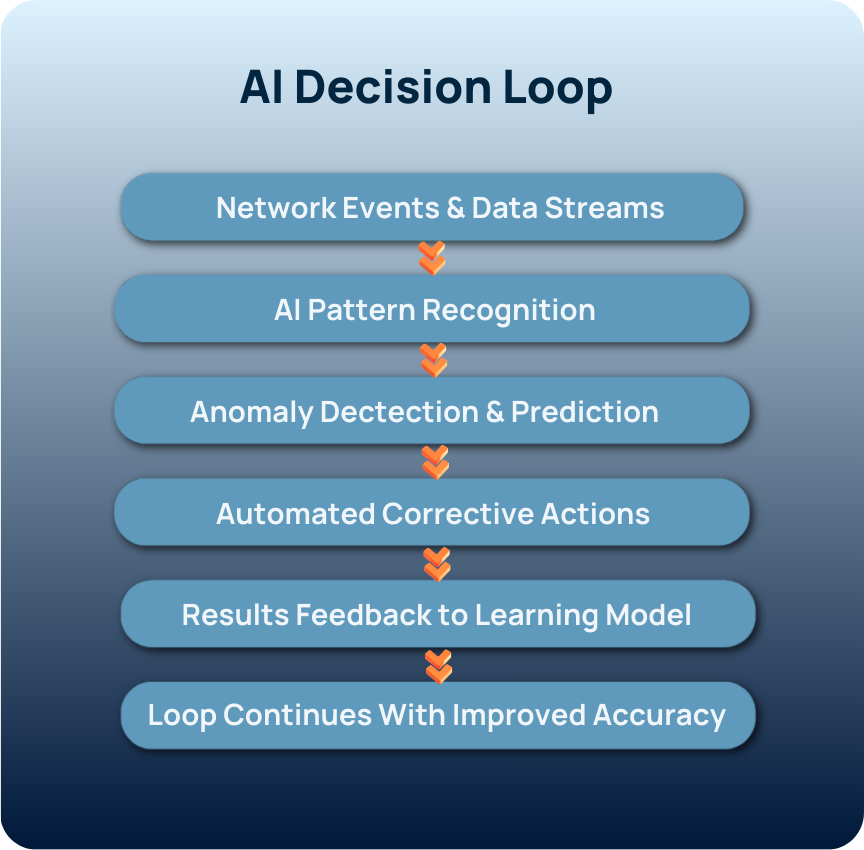
The AI Decision Loop
Here’s how embedded AI creates a continuous feedback loop that improves over time. This shows the path from data ingestion to autonomous action:
The Human Side: Partnership, Not Replacement
For engineers, embedded AI doesn’t replace responsibility. It removes the repetitive, frustrating work that consumes time without adding value. Chasing false alarms, reconciling mismatched records, validating orders: AI handles these tasks, leaving engineers with space for meaningful work like network design and capacity planning.
The shift requires trust. Engineers need to understand why the system acted a certain way. Explainability isn’t optional. AI in OSS/BSS must be transparent about why it flagged an anomaly, why it rerouted traffic, why it corrected a record. When engineers see the reasoning, confidence grows and adoption becomes sustainable.
The role itself evolves. Instead of firefighting, engineers become architects of adaptive systems, guiding and refining the intelligence that now handles operational decision-making.
Not every system can support this. Legacy monolithic platforms are too rigid. Modern architecture provides the flexibility AI needs. Cloud-native and composable systems offer the agility required to integrate intelligence across domains. Growth in the coming years is expected to be driven by operators modernizing infrastructure specifically to support AI capabilities.
What Makes This Intelligence Work
Three things separate effective AI in OSS/BSS from vapourware:
- Live Data Integration: AI needs continuous access to network telemetry, inventory records, billing data, and work orders. Static snapshots don’t work. The intelligence layer must see what’s happening now, not what happened yesterday.
- Explainable Decisions: Every action AI takes needs a clear audit trail. “The system rerouted traffic” isn’t enough. Engineers need to know: what pattern triggered the decision, what alternatives were considered, what the expected outcome is.
- Continuous Learning: Networks change constantly. AI that worked perfectly last month might miss issues today if it can’t adapt. The learning loop has to be ongoing, not a one-time training exercise.
Real-world examples prove the concept. AI identifies unused circuits and abandoned assets that still consume OPEX, exposing waste operators didn’t know existed. It forecasts which services are likely to breach SLA commitments, giving teams time to prevent penalties. Self-healing networks don’t just detect problems anymore. They initiate corrective actions like rerouting traffic, adjusting provisioning, or disabling duplicates without requiring manual intervention.
These aren’t future possibilities. They’re happening now in production environments.
The most valuable AI in telecom isn’t the kind customers interact with. It’s the intelligence inside OSS and BSS that keeps records accurate, predicts problems before they affect service, and ensures revenue matches network reality.
The impact shows up in what doesn’t happen: reconciliations that no longer drag on for months, outages that never reach customers, compliance reports that appear without effort. These quiet wins add up to stronger, more resilient operations.
For telcos, the path forward isn’t about layering another tool on top of existing systems. It’s about embedding intelligence so deeply that OSS and BSS effectively think for themselves. Operators who adopt AI in OSS/BSS will deliver networks that appear effortless to customers, precisely because the intelligence behind them does the hard work quietly in the background.
Platforms like VC4’s Service2Create (S2C) make this transition practical. Built as a cloud-native, low-code OSS/BSS platform, S2C supports AI-driven operations with live inventory reconciliation, automatic inconsistency detection, SLA forecasting, and explainable AI outputs. Engineers understand the “why” behind every system action, building the trust necessary for successful adoption.
Quick Answers: Understanding AI in OSS/BSS
Q: What is AI-embedded OSS/BSS?
A: AI embedded within OSS and BSS systems that continuously analyzes network data, predicts failures, corrects inventory discrepancies, and prevents revenue leakage without manual intervention. Unlike automation that follows fixed rules, embedded AI adapts as network conditions change.
Q: How does AI in OSS/BSS differ from regular automation?
A: Automation executes predefined workflows. AI rewrites those workflows based on evolving conditions. When network behaviour changes, automation breaks. AI adjusts.
Q: What is the financial impact of revenue leakage in telecom?
A: TM Forum’s Revenue Assurance Survey as reported on from Ericsson, estimates global telecom revenue leakage at 1.5% of overall revenue, caused by billing errors, duplicate services, and provisioning mistakes. AI detects these anomalies as they happen, preventing losses rather than discovering them months later.
Q: Can AI in OSS/BSS actually reduce network outages?
A: Yes. AI recognizes degradation patterns in signal quality, latency, and error rates before alarms trigger, giving operators time to fix issues before customers notice.