AI is Ready to Run Telecom Networks. The Data Isn’t

Trusted by:























Why the Dark NOC Vision Stalls without Accurate Network Inventory
Telecom operators are chasing something that would have sounded like science fiction ten years ago: a Dark NOC. The idea is that a Network Operations Center runs itself. Smart software monitors the network around the clock, catches faults before they escalate, figures out the root cause, and fixes the problem, all without waking anyone up or waiting for a shift to start. For operators managing thousands of network elements across multiple technologies, the appeal is obvious. Fewer human bottlenecks mean faster resolution, lower operational costs, and a network that does not grind to a halt every time something unexpected happens. According to TM Forum, reaching that level of autonomy can cut operations and maintenance costs by up to 55%. The technology to make this happen exists today. The problem is that the data those systems depend on, in most networks, is nowhere near ready to support it.
What a Modern Telecom Network Actually Looks Like
The data problem does not exist in isolation. It is a direct consequence of how complex modern telecom networks have become. These are not single systems with a handful of components to track. They are layered environments built from multiple generations of technology, different vendor platforms, and dozens of interconnected systems, all running simultaneously to deliver one seamless service to the end customer. To keep track of all of that accurately, you first need to understand what you are actually dealing with.
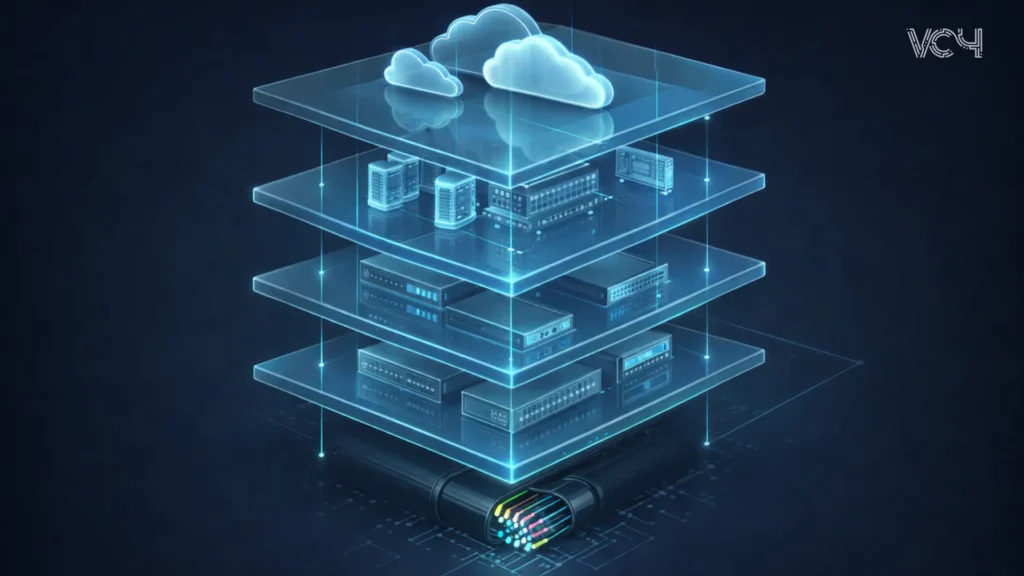
Think about what happens when a commercial flight takes off. The passenger sees a seat, a screen, and a destination. What they do not see is the air traffic control system, the fuel management, the navigation, the mechanical checks, the cabin pressure systems, and the ground crew coordination all running at the same time, managed by different teams, each with their own systems and processes. Remove or miscommunicate any one of those layers and the flight does not happen safely. A telecom network works in exactly the same way. What looks like a single service to the end customer is actually ten to thirty layers of infrastructure, from physical fiber in the ground all the way up to virtual networks and live customer connections, each managed by different systems, often by different teams, sometimes by different vendors entirely.
And that is just the baseline. In reality, these networks are constantly evolving. Engineers upgrade equipment, swap out hardware, reroute traffic, and add new services on a daily basis. Every one of those changes needs to be accurately recorded across all those layers, by all those teams, in all those systems. When that does not happen consistently, and in most networks it does not, the documented picture of the network starts drifting away from what is actually there. That drift is the root of the data problem, and it is what makes building reliable automation so much harder than it should be.
Outdated Inventory is Where Automation goes Wrong
Every change made to a network, big or small, needs to be accurately reflected in the inventory records. But in most networks, that simply does not happen consistently. Changes get logged in disconnected spreadsheets, siloed databases, and legacy systems that do not talk to each other. Some changes never get recorded at all. Over time, what started as a small discrepancy between the records and reality grows into a gap that is wide enough to cause serious operational problems.
For operators working toward a Dark NOC, this is where things get critical. Automated systems do exactly what they are designed to do, they act on the data in front of them. When the inventory is wrong, automation does not just underperform, it causes real operational damage. According to the IBM Institute for Business Value, nearly half of chief operations officers across industries consider data quality their biggest operational challenge. In telecom, the consequences of getting it wrong are not just operational. They reach customers directly through degraded services, slower fault resolution, and broken SLA commitments.
One Platform, One Version of the Network
Operators have known about the inventory accuracy challenge for years. What has changed is the cost of ignoring it. As networks grow more complex and automation takes on more operational responsibility, inaccurate inventory stops being an inconvenience and becomes a direct risk to service quality and customer experience. The question is no longer whether to fix it, but how.
The answer starts with consolidating everything into one platform that the entire organization works from. That is what VC4’s Service2Create does. Rather than having network data scattered across disconnected systems, Service2Create brings it all together into one centrally managed system, giving field engineers, network planners, finance teams, and senior management a single consistent view of the network, each presented with what is relevant to their role. Having everyone work from the same accurate data removes the inconsistencies that cause automated systems to make wrong decisions. The next question is how that data stays accurate as the network keeps changing.
Keeping Inventory Aligned with Reality
Keeping network inventory accurate is not a one-time exercise. Every day, new equipment gets installed, connections get added, and hardware gets swapped out across the network. The moment a platform stops actively tracking these physical changes and reflecting them in the inventory, the records start falling out of step with reality. The only way to stay ahead of inventory drift is to have the system continuously comparing what it holds on to record against what is actually live in the network and correcting itself when it finds a difference. Service2Create does this through its Network Reconciliation and Auto Discovery functionality.
When Service2Create finds new equipment, new connections, or hardware changes that have not been recorded yet, it updates the inventory automatically. When a discrepancy is more complex and needs a human decision, it surfaces the difference clearly so engineers can review and resolve it in one place rather than hunting across multiple systems. With the inventory continuously synchronized with the live network, operators have something they can genuinely build on.
What Accurate Data Actually Makes Possible
Getting the inventory right is not the end goal, it is the starting point for everything that follows. When Service2Create has an accurate and continuously updated view of the entire network, service delivery becomes a fundamentally different process. Engineers know exactly what infrastructure is available, where it is, and what state it is in. New services get designed and provisioned directly into the network without the delays that come from manually hunting down availability across disconnected systems. Organizations also stop spending on hardware they do not actually need, because for the first time they can see clearly what they already have.
Network reliability improves for the same reason. When the topology data is accurate, it becomes possible to run the kind of checks that manual processes simply cannot keep up with at scale. Service2Create can detect where a primary service path and its backup are both routed through the same physical fiber cable or manhole. If that shared route fails, whether through a cable cut or flooding, both the primary service and its protection go down simultaneously. Catching and resolving vulnerabilities like this before a physical failure occurs is what separates operators who are genuinely in control of their networks from those who are constantly responding to problems they never saw coming.
And when faults do occur, accurate inventory changes how fast and effectively the operation responds. The moment an alarm fires, the system identifies the affected equipment and calculates the customer service impact immediately, without engineers having to trace through the network manually. It also knows exactly where the nearest compatible spare part is located across all warehouses, so the right component gets dispatched without logistics and network operations having to coordinate across separate systems. The time between a fault occurring and a customer’s service being restored is significantly reduced.
The Clear Path to Autonomous Operations
The Dark NOC vision is not held back by a lack of technology. The tools exist. What holds it back is the quality of the data the automation tools are being asked to work with. Most operators are sitting on network inventory that is fragmented, out of date, and inconsistent across systems. Fragmented and outdated inventory is the gap between where operators are today and the autonomous operations they are working toward. Solving inventory accuracy is where the journey to autonomous operations has to begin.
Operators who get their network inventory right first, who establish a single accurate view and keep it synchronized with reality, are the ones who will get to autonomous operations fastest. Not because they have better AI, but because their AI has better data to work with. That is the foundation the Dark NOC is built on.
Talk to the VC4 team to find out how Service2Create can help your organization get started.