When Leased Lines Disappear From Your Billing System

Trusted by:
























Leased lines carry the world’s most critical services: banking transactions, emergency communications, government networks, corporate WANs. When operators can’t confidently state where a circuit runs, who owns it, or whether it’s properly billed, the consequences go beyond operational frustration. Revenue vanishes. Customer trust erodes. And nobody notices until an audit reveals you’ve been giving away services for free. For months.
The problem isn’t new, but it’s getting worse. As networks grow more complex with virtualization, multi-vendor environments, and dynamic provisioning, circuit visibility has become harder to maintain. Many operators discover the gap only when a “disconnected” service still shows up at a customer premise, or when an audit reveals dozens of active lines generating zero billing revenue.
The fix requires rethinking OSS architecture so that visibility becomes intrinsic to system behavior, not an afterthought patched on later.
The Revenue Problem Hiding in Plain Sight
Revenue leakage in telecom ranges from 1% to 5% of total annual revenues according to Wipro and BillRun industry analysis, with dedicated circuits representing a particularly vulnerable segment. The issue isn’t dramatic network failures. It’s the silent drift between what exists in the network and what appears in billing systems.
Here’s what happens: A circuit gets provisioned. Months pass. The customer uses it daily. But somewhere in the chain between network activation and billing, the record gets lost. Maybe the work order never closed. Maybe a system migration dropped the entry. Maybe a field tech made a change that never propagated to inventory.
The circuit continues running. The customer experiences no service issue. But the operator never bills for it. Multiply this scenario across hundreds or thousands of circuits, and the financial impact compounds into millions in lost annual revenue.
Enterprise customers notice these discrepancies too. When SLA credits take weeks to process because operations can’t quickly validate circuit paths, or when a customer receives billing for a “disconnected” service they’re still actively using, confidence erodes. Each unresolved mismatch tells the customer their operator doesn’t have full control of the network they’re paying for.
Visibility in dedicated circuits isn’t just operational hygiene. It’s a promise to customers that every connection matches what’s contracted, billed, and maintained exactly as agreed.
Architectural Shifts
Traditional OSS treats inventory as static documentation. Systems create records at provisioning, teams update them occasionally during maintenance, and someone corrects them when problems surface. This reactive model worked when networks changed slowly and circuit counts stayed manageable.
Modern networks don’t offer that luxury anymore. Changes happen constantly: circuits get rerouted, equipment gets upgraded, vendors get swapped, services get modified. Static documentation can’t keep pace.
See Below: Building visibility into OSS architecture requires specific shifts in how systems handle leased line data. These are fundamental changes in system behavior that transform leased lines from static records into continuously validated assets:
| Traditional OSS Approach | Visibility-Driven OSS Approach | Impact on Operations |
|---|---|---|
| Static inventory records | Self-healing, auto-updating inventory | Stop losing track of active circuits worth millions |
| Provisioning isolated from billing | Service definitions embed commercial context from start | Catch unbilled circuits before they cost you revenue |
| Quarterly reconciliation audits | Continuous automated reconciliation | Find mismatches in hours, not after quarterly audits |
| Separate physical/logical/billing IDs | Unified identity across all layers | Trace any circuit from customer port to invoice instantly |
| Single-layer circuit views | Multi-layer lineage mapping | See complete paths across every technology and vendor |
This changes everything about how OSS works. Instead of documenting circuits after they’re built, the system maintains live awareness of every connection’s technical and commercial state simultaneously.
Self-healing inventory means when a circuit changes in the network, the system detects and updates records automatically. Commercial context embedded at provisioning ensures billing data travels with the connection from day one. Continuous reconciliation catches discrepancies within hours instead of waiting for quarterly audits.
Unified identity gives every connection a single reference that maps across physical ports, logical circuits, and billing IDs. Multi-layer lineage allows operators to trace a complete path from customer interface through transport networks to the destination endpoint, regardless of how many technologies or vendors it crosses.
PRO TIP: Start your visibility transformation by mapping all active leased lines back to their billing records. Most operators discover 10-20% of circuits have no corresponding billing entry, while another 5-10% of billed services no longer exist in the network. Fixing these two gaps immediately recovers revenue and prevents future leakage.
Business Impact Beyond Revenue Recovery
When operators move from periodic documentation to continuous circuit assurance, the benefits extend beyond plugging revenue holes.
SLA disputes shrink dramatically. When a customer questions service delivery or requests SLA credits, operators can prove actual performance and circuit status in real time rather than spending days reconstructing history from logs.
Network changes propagate correctly. Field technicians make adjustments knowing the system will capture and distribute changes automatically. Provisioning teams see current state before making new assignments. Finance teams trust that billing reflects active services.
Audit transparency improves. Both internal auditors and external regulators get clear documentation showing every circuit’s complete lifecycle from contract through deployment, maintenance, and billing. The paper trail exists because the system creates it naturally during normal operations.
Teams stop firefighting and start planning. That changes how the whole company operates.

Phased Implementation: Blind Spots to Clarity
Transforming circuit visibility doesn’t require shutting down operations for a massive overhaul. Successful operators take a phased approach that delivers value at each stage while building toward complete visibility.
Phase 1: Assessment and Discovery
Start by understanding the current state. Audit OSS records, billing data, and live network to uncover discrepancies. Map orphaned circuits that exist in the network but nowhere else. Find ghost billing where you’re charging customers for services that don’t exist. This phase typically reveals uncomfortable truths. Most operators discover their records are more fiction than fact. That stings, but at least you know what you’re dealing with. It quantifies the problem and justifies the investment needed to fix it.
Phase 2: Automated Data Collection
Deploy discovery agents and API integrations to capture live circuit data from network devices, NMS platforms, and EMS systems. The goal is creating continuous data flow from the network into inventory without manual intervention. It’s also establishing persistent connections that update inventory as the network changes. When a field tech modifies a circuit, the system sees it immediately.
Phase 3: Continuous Reconciliation
Implement automated reconciliation that runs 24/7, comparing live network state against OSS records and billing entries. When mismatches appear, the system flags them for correction immediately rather than waiting for the next audit cycle. This transforms reconciliation from a periodic project into an ongoing operational capability. Discrepancies get caught while they’re still fresh and easy to fix.
Phase 4: Commercial Integration
Link leased line inventory directly to billing and CRM systems. Embed customer information, SLA terms, and pricing data into provisioning workflows so commercial details travel with circuits from initial order through activation and billing. This phase closes the loop between technical operations and financial systems. When circuits get provisioned, billing activates. When circuits get disconnected, billing stops. The gap where revenue leakage occurs simply disappears.
Phase 5: Predictive Assurance
Apply analytics to detect anomalies early and forecast capacity needs. Move toward zero-touch assurance where circuit visibility maintains itself automatically, flagging only issues that require human attention. This final phase represents true operational maturity. The system doesn’t just document connections or reconcile them. It actively manages them, predicting problems before they occur and ensuring continuous alignment between network reality and business records.
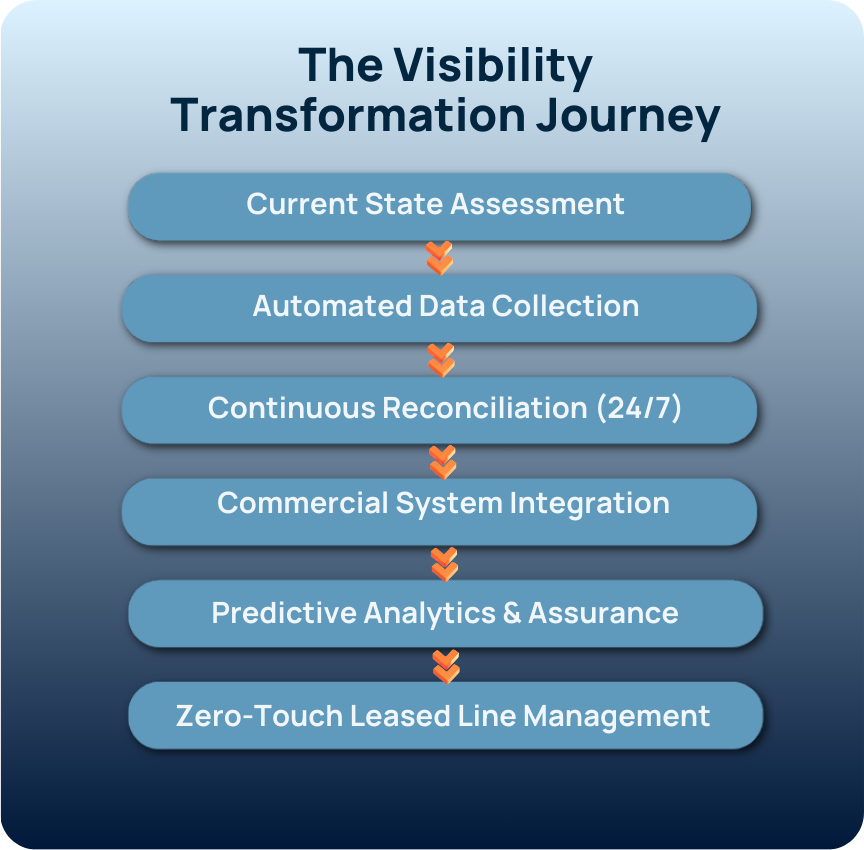
The Visibility Transformation Journey
Here’s how the phased approach builds from basic discovery through predictive assurance. Each phase delivers measurable value while preparing the foundation for the next level of capability:
Circuit Visibility Becomes A Competitive Advantage
End-to-end circuit visibility is about repositioning the network as a trusted, agile service platform. When you can see everything, you movie faster. New services launch quicker. Capacity planning gets easier. SLAs actually get met.
When every connection maps to its real commercial and technical state, decisions shift from reactive fixes to proactive growth. In this industry margins stay tight and competition intensifies, the ability to act on true network state becomes the foundation for profitability, customer trust, and long-term market position.
Making this transformation requires the right platform foundation. Cloud-native OSS platforms like VC4’s Service2Create enable this transformation by delivering true end-to-end visibility with multi-layer mapping, commercial integration, and continuous reconciliation. They have a dedicated module specifically suited to leased lines which equips operators not only to prevent revenue loss but to confidently expand services, maximize asset utilization, and strengthen customer trust. That turns visibility from an operational necessity into a long lasting competitive advantage.
Questions That Reveal Revenue Risk for Leased Lines
What is end-to-end visibility in leased lines?
It’s the ability to track a leased line across all layers (physical, logical, and commercial) from provisioning to billing, with real-time accuracy.
Why do leased lines cause hidden revenue loss?
When leased lines remain active in the network but are detached from billing systems, operators lose revenue, sadly, often due to outdated inventory or poor change tracking.
Do operators need to replace their OSS to gain visibility?
No. A modern visibility layer can be integrated into existing OSS environments, enabling real-time updates, multilayer mapping, and billing-grade inventory without system replacement.
How can telecoms detect orphaned or unbilled leased lines?
By using continuous reconciliation tools that compare the live network state with OSS records and billing data, ensuring every leased line is accounted for and monetised.
References
- Wipro – “The Smart Route to Revenue Assurance” https://www.wipro.com/communications/articles/the-smart-route-to-revenue-assurance/ (Revenue leakage ranges from 0.5% to 10%, averaging 1-5% of total revenues)
- BillRun – “Prevent Under-the-Radar Revenue Losses” https://bill.run/blog/revenue-leakage (Revenue leakages can range from 1% to 5% of total annual revenues)
- Further Reading – VC4 – “Telecom Research: The Risks of Leased Line Cost Models” https://www.vc4.com/blog/telecom-reserach-on-leased-line-costs/ (Billing frequently diverges from real network conditions in leased lines)